
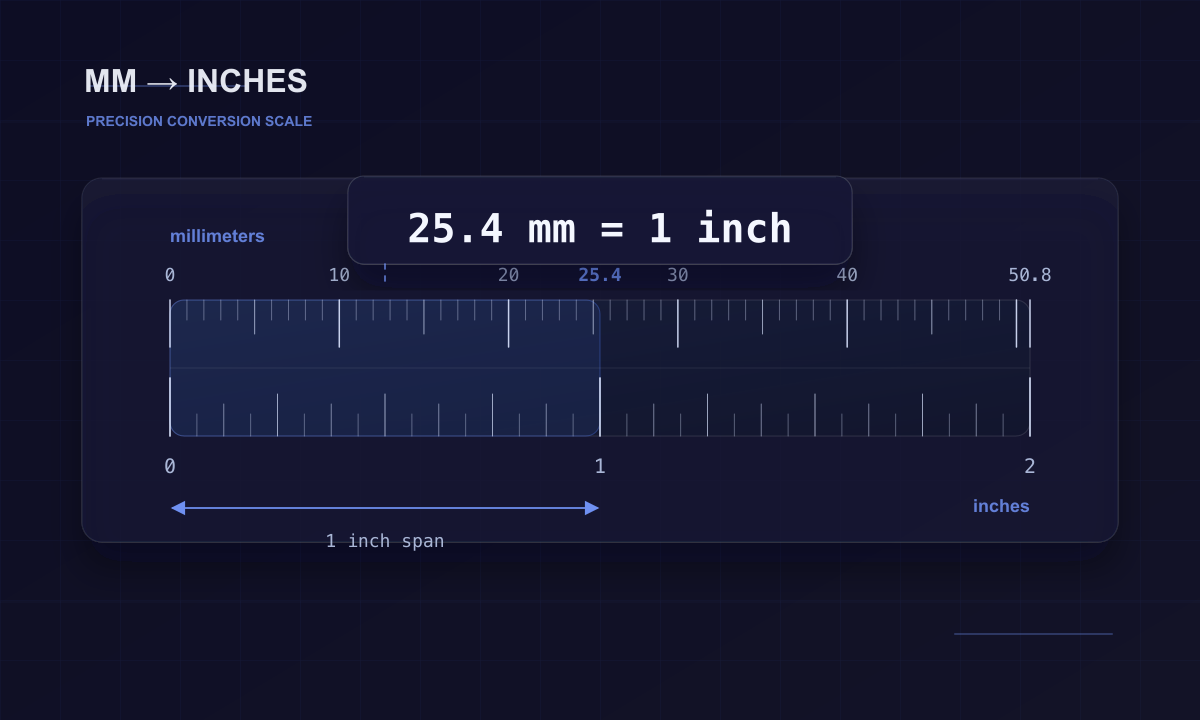
Short answer first, because that is probably why you are here: to convert mm to inches, divide the millimeters by 25.4. So 50 mm is 50 ÷ 25.4 = 1.9685 inches. If you want the result instantly, paste your number into our mm to inches converter and you are done.
If you want to actually understand the conversion — enough to sanity-check a supplier drawing, read a metric bolt callout, or stop second-guessing yourself at the hardware store — stick around. This tutorial walks through the whole thing with worked examples, and it stays practical. No unit-conversion trivia beyond the one date that matters.
The only rule you need: 1 inch = 25.4 mm
The inch is not some fuzzy, historical unit anymore. Since 1959, the international inch has been defined as exactly 25.4 millimeters. Not 25.399, not "about 25 and a half". Exactly 25.4. The United States, the UK, Canada, Australia and the rest of the industrialized world all signed on to the same definition.
That single fact gives you both conversion formulas:
inches = mm ÷ 25.4 (mm → inches)
mm = inches × 25.4 (inches → mm)
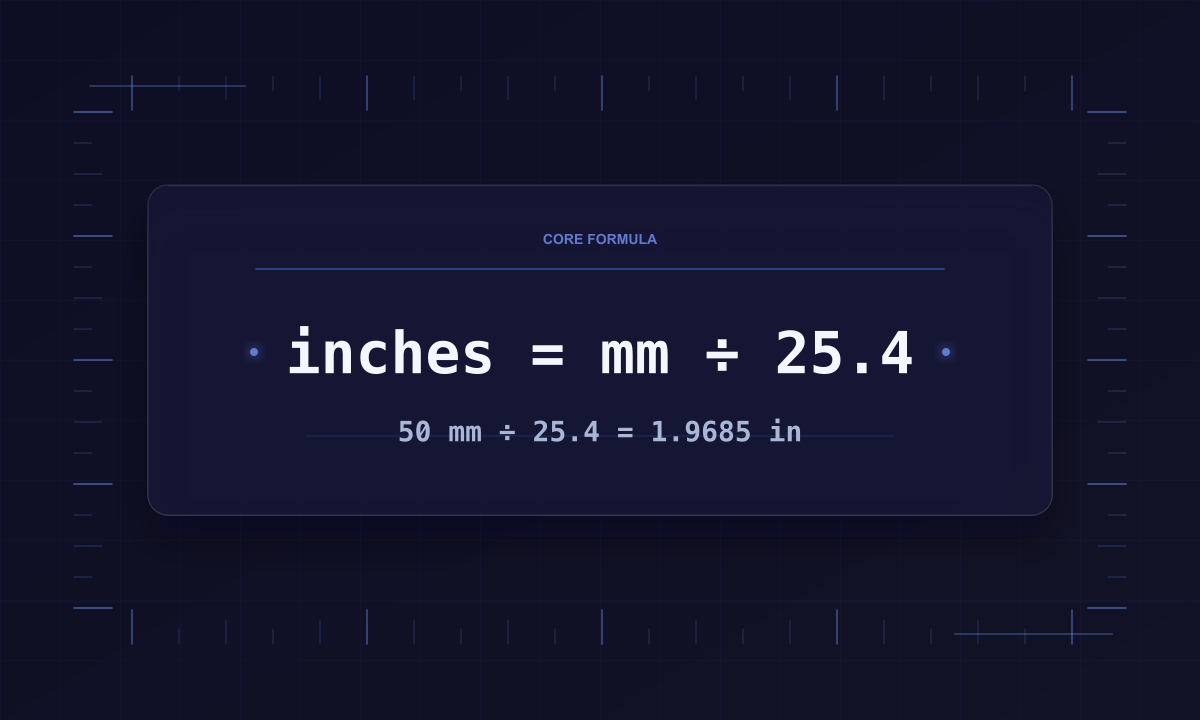
Because the definition is exact, any two correct converters will always agree to every decimal place. If a chart you find online disagrees with a calculator, the chart rounded somewhere — the math itself has no wiggle room.
Converting mm to inches by hand, step by step
Let's convert 120 mm without a calculator to show there is no magic involved.
- 1Write down the division:
120 ÷ 25.4. - 2Estimate first so you can catch mistakes: 25.4 × 4 = 101.6 and 25.4 × 5 = 127, so the answer sits between 4 and 5 inches, closer to 5.
- 3Do the division:
120 ÷ 25.4 = 4.7244. (Long division works; so does your phone.) - 4Round to what the job needs. Woodworking? 4.72″ is plenty. Machining? Keep 4.7244″ and mind your tolerances.
A few more examples you can check against the calculator:
- 10 mm ÷ 25.4 =
0.3937 in— the classic socket size - 25 mm ÷ 25.4 =
0.9843 in— just shy of one inch - 3.2 mm ÷ 25.4 =
0.126 in— a common 3D-printer nozzle-adjacent size, almost exactly 1/8″ - 300 mm ÷ 25.4 =
11.811 in— the "metric foot", noticeably shorter than 12″
The faster way: let the converter do it
Hand math is good for understanding, but for daily work you want the answer in the time it takes to type the number. That is exactly what we built MMScaler for. Type a value in the millimeter field and the inch value appears as you type, to six decimal places, along with the nearest fraction.

A few things in that screenshot worth pointing out, since people miss them:
- The fraction line under the result (≈ 3 15/16″) is the value your tape measure can actually find.
- The swap button between the fields flips the direction to inches to mm — same rule, multiplied instead of divided.
- Copy result puts the full-precision number on your clipboard, so what lands in your CAD file is the exact value, not what you retyped.
Every popular value also has its own page with the decimal, the fraction, centimeters and feet in one place. Here is the one for 10 mm:

Getting fractional inches (the tape-measure problem)
Decimal inches are fine on a screen and useless on most tape measures. Imperial tapes are divided into sixteenths, so 0.3937 in means nothing until you know which tick mark it lands near. Here is the conversion, continuing with 10 mm:
- 1Convert to decimal inches:
10 ÷ 25.4 = 0.3937. - 2Multiply the decimal part by 16:
0.3937 × 16 = 6.3. - 3Round to the nearest whole number:
6. - 4Put it over 16 and reduce:
6/16 = 3/8″.
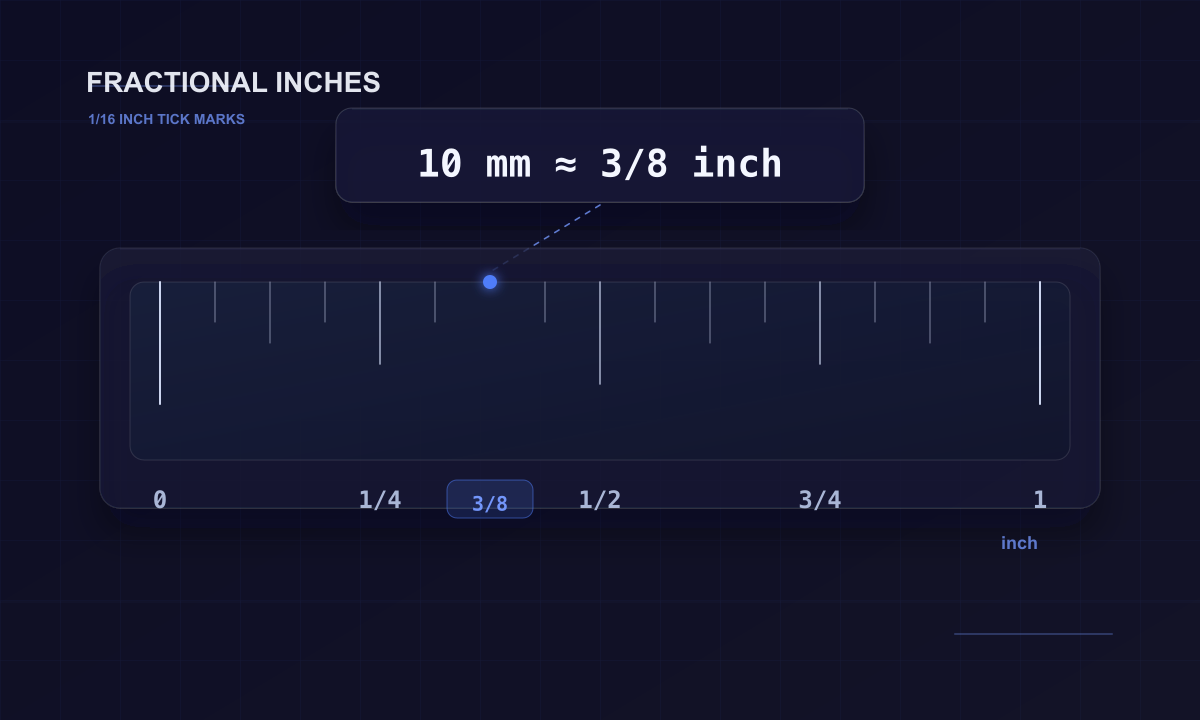
Keep in mind the rounding cost you something. 3/8″ is 9.525 mm, so calling 10 mm "3/8 inch" hides almost half a millimeter of error. For carpentry that is invisible; for a press-fit dowel it is a ruined hole. When the fraction matters, our fraction converter lets you pick 1/16″, 1/32″ or 1/64″ precision and shows the rounding error explicitly.

A quick reference chart
For workshop walls and toolbox lids, a printed chart still beats any app. Here are the values that cover most day-to-day work; fractions are rounded to the nearest 1/16″:
| MM | Inches (decimal) | Inches (fraction) |
|---|---|---|
| 1 mm | 0.0394 in | 1/16" |
| 2 mm | 0.0787 in | 1/16" |
| 3 mm | 0.1181 in | 1/8" |
| 4 mm | 0.1575 in | 3/16" |
| 5 mm | 0.1969 in | 3/16" |
| 6 mm | 0.2362 in | 1/4" |
| 8 mm | 0.315 in | 5/16" |
| 10 mm | 0.3937 in | 3/8" |
| 12 mm | 0.4724 in | 1/2" |
| 15 mm | 0.5906 in | 9/16" |
| 20 mm | 0.7874 in | 13/16" |
| 25 mm | 0.9843 in | 1" |
| 30 mm | 1.1811 in | 1 3/16" |
| 40 mm | 1.5748 in | 1 9/16" |
| 50 mm | 1.9685 in | 1 15/16" |
| 100 mm | 3.937 in | 3 15/16" |
The full printable chart runs from 1 mm to 1000 mm and prints cleanly on a single page:

Estimating in your head
You will not always have a converter handy, and honestly you do not always need one. Three tricks cover most situations:
- Divide by 25 and shave a little. 80 mm ÷ 25 = 3.2, and the true answer is 3.15″. Dividing by 25 always overshoots by about 1.6%, so round your estimate down slightly.
- Anchor on 100 mm ≈ 4 inches. It is really 3.937″, but "100 mm is four inches" gets you through furniture shopping. 500 mm ≈ 20″, 1000 mm ≈ 40″ (actually 39.4″).
- Memorize the workshop trio: 6 mm ≈ 1/4″, 13 mm ≈ 1/2″, 19 mm ≈ 3/4″. Those three cover a shocking share of drill bits, wrenches, and plywood thicknesses.
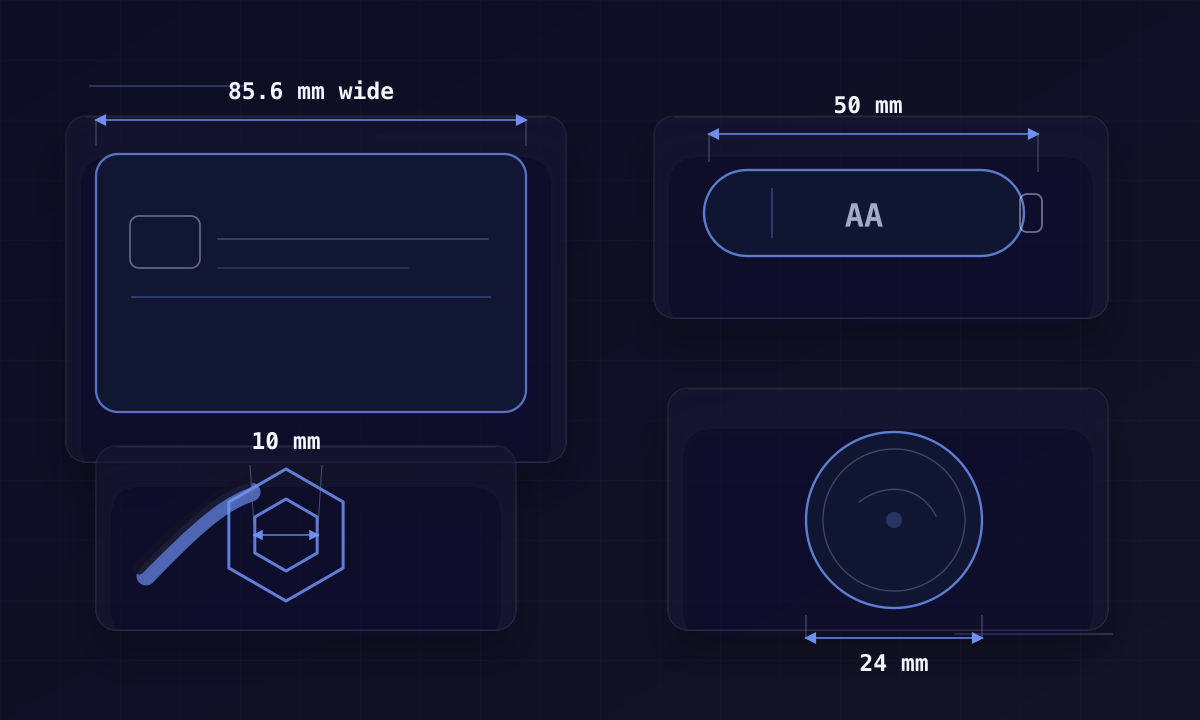
To build intuition, it helps to hang the numbers on objects you already know the feel of:
When close enough isn't: precision and tolerances
One last thing worth knowing before you round anything. How many decimals you keep should follow the job, not habit:
- Rough carpentry, furniture, packaging: one decimal of an inch is fine. 0.1″ is 2.5 mm — you can see that with a naked eye.
- Cabinetry and 3D printing: keep two or three decimals. A first-layer offset of 0.1 mm (0.004″) is the difference between a print that sticks and one that peels.
- Machining: keep everything and convert at the last step. Machinists talk in thousandths of an inch ("thou"), and 1 thou is 0.0254 mm. Converting early and rounding twice is how parts end up scrapped.
This is also why our converter shows six decimal places. Not because your saw can hold a millionth of an inch, but because rounding should be your decision, made once, at the end.
Frequently asked questions
What is the formula to convert mm to inches?+
Divide the millimeter value by 25.4. For example, 50 mm ÷ 25.4 = 1.9685 inches. The rule works for any value because the inch is defined as exactly 25.4 mm.
How many mm are in an inch?+
Exactly 25.4 millimeters. This has been the international definition of the inch since 1959, so it is not an approximation.
What is 10 mm in inches?+
10 mm equals 0.3937 inches, which is just a hair under 13/32″ and commonly matched to 3/8″ on a tape measure. A 10 mm socket and a 3/8″ socket are close, but not interchangeable on tight fasteners.
How do I convert mm to fractional inches?+
Divide by 25.4 to get decimal inches, multiply the decimal part by your denominator (16 for sixteenths), round to the nearest whole number, and put it over the denominator. 30 mm → 1.1811 in → 0.1811 × 16 ≈ 3 → 1 3/16″.
Is 20 mm the same as 3/4 inch?+
Close, but no. 20 mm is 0.7874 inches, while 3/4″ is 0.75 inches (19.05 mm). The difference is almost a full millimeter — enough to matter for bolts, bearings, and pipe fittings.
Can I just divide by 25 to estimate?+
Yes, for rough estimates. Dividing by 25 instead of 25.4 overshoots by about 1.6%, which is fine for eyeballing furniture or packaging but not for machining or 3D-printer calibration.
Wrap-up
That is the whole subject: divide by 25.4, multiply by 16 when you need a fraction, and keep your precision until the last step. Bookmark the converter for exact answers, print the chart for the workshop, and if you mostly work the other direction, the inches to mm converter has you covered too.